
On this page
Key takeaways
- If buyers ask AI who to hire and a business never appears, that is a citation problem, not a ranking problem.
- On-page clarity makes a business eligible to be cited. Off-site proof is what gets it chosen.
- Start with the lists AI already reads and a complete Google Business Profile.
- Measure AI visibility on its own: score persistence across repeat runs, not one lucky appearance.
For twenty years, the goal was simple: get to page one. That playbook is breaking. Not because SEO stopped working, but because the answer now appears before the list.
Google is expanding AI Overviews into full AI Mode-style responses on more local queries. The follow-up box loads by default, the answer takes the top of the screen, and the organic listings that used to be “above the fold” get pushed well below it. ChatGPT and Perplexity do the same thing in a different window: they name two or three businesses and move on.
When a system names only a handful of businesses, being ranked #4 and being invisible start to look the same. The businesses that get named are not always the ones with the best websites. They are the ones the AI can verify, corroborate, and quote without guessing.
The shift
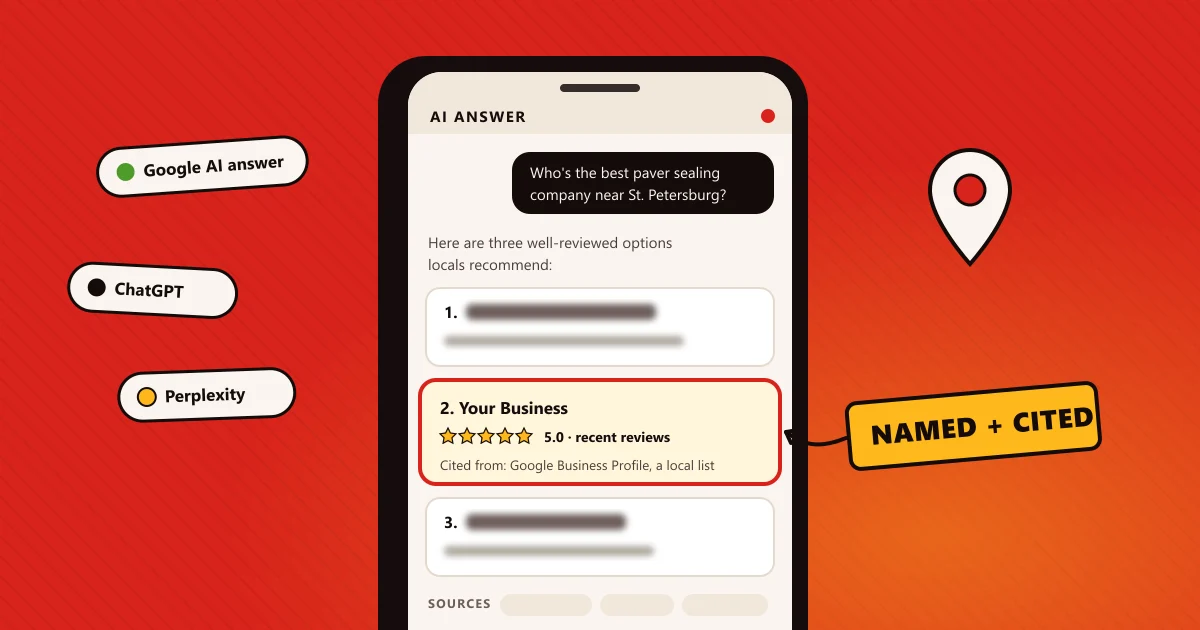
If buyers ask AI who to hire and a business never appears in the answer, that business does not have a ranking problem. It has a citation problem.
What AI actually pulls from when it recommends a local business
Recent large-scale studies point in the same direction, even though they measured different platforms.
42%
BrightLocal · ~1.9M citations
Business websites still supply the source material.
In BrightLocal's analysis of more than 200,000 localized prompts and roughly 1.9 million citations, business websites accounted for about 42% of all citations and the vast majority of unique domains cited. A clear, current website is not optional. It is the document AI quotes from.
BrightLocal · same study
The Google Business Profile does heavy lifting.
The same research found a substantial share of local AI citations trace back to GBP data: categories, services, hours, reviews, and photos. When GBP information is thin or inconsistent, the AI has less to repeat with confidence.
#1
Whitespark · 2026 ranking factors
Third-party corroboration decides who makes the short list.
Whitespark's 2026 Local Search Ranking Factors survey of leading local SEO practitioners ranked presence on expert-curated “best of” lists as the top AI-visibility factor. Dedicated service pages, presence on industry-relevant sites, and the quality of unstructured mentions (news, blogs, directories, community pages) rounded out the top signals.
~3×
Ahrefs · 75,000 brands
Mentions now outweigh backlinks.
Ahrefs' study of 75,000 brands found branded web mentions correlated with AI Overview visibility at about 0.664, compared with about 0.218 for backlinks, roughly three times stronger. Correlation is not causation, and large brands naturally earn both more mentions and more citations, but the pattern is consistent across studies: reputation that shows up in text matters more than link counts alone.
Put together, the model is straightforward. On-page clarity makes a business eligible to be cited. Off-site proof (GBP completeness, reviews, list placements, and mentions in places AI already trusts) is what gets a business chosen.
The 10 tactics that get local businesses cited, ranked
The order matters. The first five tactics create the foundation AI needs to name a business at all. The next five increase how often that happens.
Tactics 1 to 5
The foundation
What AI needs to name a business at all.

- Highest leverage
Get onto the lists AI already reads.
This is the single highest-leverage move. AI systems lean heavily on curated roundups: “best plumber in Tampa,” “top-rated dentists near me,” local news picks, chamber and association directories, Yelp and industry-specific lists. A business does not need to be on fifty lists. It needs to be on the three to five lists that actually surface for its category and city. Audit which sources AI cites for competitors, then pursue placement on those exact sources.
Treat the Google Business Profile as a primary source document.
Complete every field of the Google Business Profile: primary and secondary categories that match the work actually performed, a full services list with plain-language descriptions, current hours (including holidays), photos of real work and team, and attributes. Keep the profile active. AI systems favor businesses whose information looks maintained, not abandoned.
Earn brand mentions, not just links.
A mention is a business name appearing in a relevant context (a local article, a supplier page, a sponsorship listing, a podcast transcript, a community roundup), even without a hyperlink. One strong mention on a trusted local or industry site can carry more AI weight than several low-quality backlinks. Think digital PR and partnerships, not link schemes.
Build one dedicated page per service, written to be quoted.
Each core service gets its own page. Lead with a direct answer in the first few sentences: what the service is, who it is for, where it is offered, and what it typically costs. Follow with specifics: process, timeline, guarantees, and common questions. Pages that bury the answer under generic marketing copy are hard for AI to extract and easy to skip.
Keep reviews fresh, specific, and answered.
Recency and detail matter more than a large lifetime total. Reviews that name the service (“paver sealing,” “emergency AC repair”) and the neighborhood give AI quotable proof. A steady flow of recent reviews, with owner responses, signals an active business. Ask for reviews at the moment of satisfaction and make the link effortless to use.
Tactics 6 to 10
The multipliers
What makes it happen more often.

Publish content AI can lift without editing.
Short, self-contained passages work best: a clear definition, a price range with context, a step-by-step process, a comparison with honest trade-offs. Add dates and update them. Pages that state facts plainly get quoted; pages that rely on vague superlatives do not.
Lock down consistency everywhere AI looks.
Name, address, phone, hours, and service descriptions should match across the website, Google Business Profile, Facebook, Yelp, Apple Business Connect, Bing Places, and the BBB. Inconsistencies force AI to guess, and AI avoids guessing when a competitor's information is clean.
- Website
- Google Business Profile
- Yelp
- Apple Business Connect
- Bing Places
- BBB
Become the list-maker in the category.
Publishing a genuinely useful local resource (a cost guide, a “how to choose” checklist, a seasonal maintenance calendar) gives other sites, and AI systems, a reason to cite the business as a source. The goal is not volume. One definitive local guide outperforms twenty thin blog posts.
Add proof that only a real business can provide.
Original photos of completed work, named team members, licenses and insurance details, years in business, and specific service-area coverage. Generic stock imagery and boilerplate “about” text give AI nothing distinctive to attach to a name.
Measure AI visibility separately and iterate.
Rankings and AI mentions move independently. A business can hold a top-three map position and still be absent from AI answers. Track both. (Measurement method below.)
What doesn't move the needle (and wastes budget)

- llms.txt files. Neither Google nor ChatGPT uses them as a ranking or citation signal. Adding one does no harm, but it does not create visibility.
- Schema markup alone. Structured data helps AI parse a page; it does not make AI choose that business over a competitor. Treat schema as hygiene, not strategy.
- Citation volume farming. Hundreds of low-quality directory listings were a weak tactic before AI and remain one. AI weights the authority and relevance of the source, not the raw count.
- Keyword-stuffed business names. Beyond violating platform guidelines, a stuffed name does not create the corroboration AI looks for, and it erodes trust with human buyers who read it.
- Set-and-forget profiles. A GBP or Facebook page created once and never updated reads as dormant to both algorithms and people. Fresh photos, current hours, and recent reviews are the visible signs of an active business.
How to measure whether it's working

AI answers are not deterministic. The same prompt can return a different short list on a repeat run, and ChatGPT, Google AI Overviews, and Google AI Mode frequently disagree with each other. That variability is the reason measurement needs its own method:
- 1Pick 15 to 25 commercial prompts buyers actually use (“best [service] in [city],” “[service] near me,” “how much does [service] cost in [city]”).
- 2Run each prompt on ChatGPT, Perplexity, and Google AI (Overviews/AI Mode) at least three times over two weeks. Record which businesses are named and which sources are cited.
- 3Score persistence, not a single appearance. A business named in 7 of 9 runs is visible. A business named once is lucky.
- 4Track the sources. When competitors are cited, note whether the citation comes from their website, GBP, a review site, or a “best of” list. That gap list becomes the work plan.
- 5Re-run monthly. AI visibility shifts as reviews, lists, and content change. Treat the tracker as a living document, not a one-time audit.
Directional is fine. The goal is not a perfect score; it is knowing whether the business is in the consideration set at all, and which competitor is taking its place when it is not.
A practical 30-day starter sprint
- Week1
GBP + consistency
- GBP fully built out
- NAP matched across top 10 profiles
- Services list complete
- Week2
Service pages
- One quotable page per core service: answer-first, price context, FAQs, updated date
- Week3
Lists + reviews
- Placed or pitched on 3 to 5 cited “best of” sources
- Review request system live
- Week4
Mentions + measure
- 2 to 3 earned mentions (partner, press, community)
- Baseline AI tracker recorded
None of this requires a website rebuild. It requires treating AI visibility as its own discipline, alongside traditional local SEO, not instead of it. The fundamentals still matter. They are now the entry ticket rather than the finish line.
The bottom line for local businesses
Buyers have not stopped searching. They have started asking. The businesses that win the next phase of local search will be the ones AI can describe accurately, corroborate independently, and quote confidently.
Most competitors have not started this work. Categories are still open, lists are still accepting placements, and the review and mention gaps are still small enough to close in a quarter. That window will not stay open indefinitely. But right now, it is.
The first step is simply knowing what AI currently says.
Sources and further reading
- brightlocal.comBrightLocal: Local AI Visibility Study200,875 localized prompts; ~1.9M citations across ChatGPT, Google AI Mode, and Google AI Overviews.
- whitespark.caWhitespark: 2026 Local Search Ranking Factors“2026 Playbook: How to Optimize Citations for AI Visibility.”
- ahrefs.comAhrefs: AI Brand Visibility Correlations75,000 brands; branded mentions ~0.664 vs. backlinks ~0.218.
Note on evidence: The studies above are vendor-published and correlational. They are best read as directional guidance on where to invest first, not as guaranteed ranking formulas. No controlled study has yet established exact causal weights for AI citation factors.

About the author
HotPepper Agency is a local SEO and AI SEO agency in St. Petersburg, FL and Marietta, GA, led by Chris Romero. We have been ranking local businesses since 2015, and now we work to get them named in AI answers too.